
Negotiating Salary for Security Cleared Talent: Clearance Impact

Table of Contents
- When Your Clearance Isn’t Just a Line Item?
- The Silent Clearance Premium Nobody Quotes
- Why Cashing Your Clearance Check Feels Wrong?
- Numbers That Actually Move the Conversation
- When Employers Push Back on Your Data?
- The Contractor Math You Need to Know
- The Poly Bonus Nobody Sees Coming
- Your Clearance Is Your Marketplace Advantage
- FAQ –
Tom stared at the offer letter from a major defense contractor. TS/SCI clearance. Eight years as a network security analyst in a classified environment. Base salary: $128,000. His research showed cleared peers hitting $145K for the same role. The email sat unanswered for two days. He knew pushing back risked the deal, but accepting lowballed him against market.
When Your Clearance Isn’t Just a Line Item?
You’ve got Secret clearance. Or Top Secret. Maybe TS/SCI with poly. Agencies and contractors need that yesterday. But most offers treat it like table stakes, not the supply constraint it actually is. Professionals with TS/SCI clearance earn an average of $131,907, compared to $93,748 for Secret clearance, a 40.6% increase. That’s not negotiable fluff. It’s math.
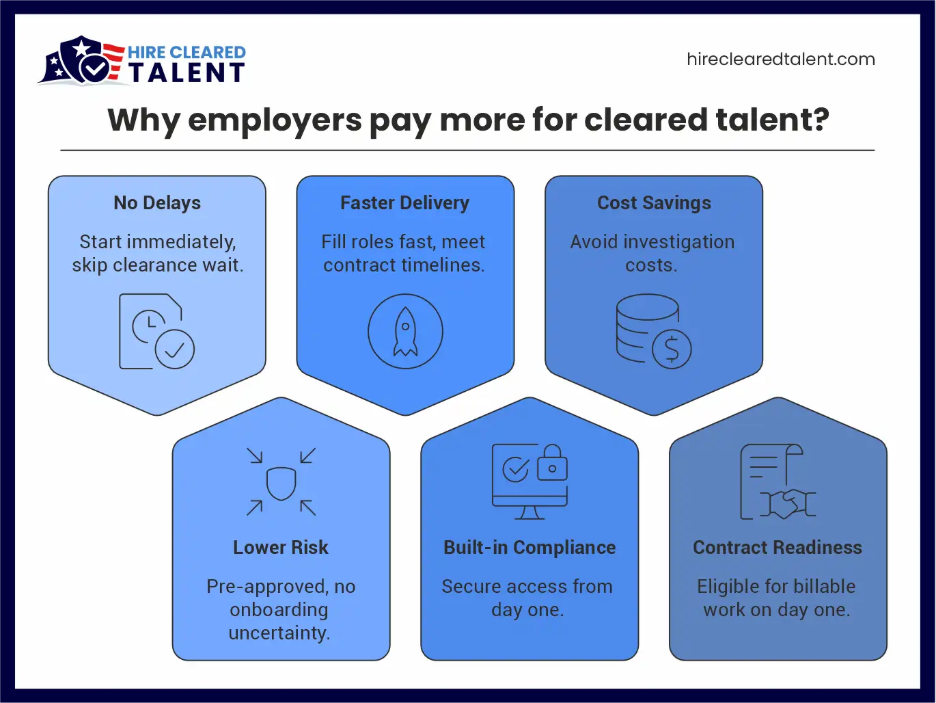
Because hiring managers know the clearance process. Secret takes 138 days minimum. Top Secret averages 249 days, sometimes stretching 18 months total from posting to productivity. They’ll pay to skip that pipeline. Your leverage lives in that timeline. But only if you name it during negotiation.
The Silent Clearance Premium Nobody Quotes
Tom’s situation wasn’t unique. He’d spent years hardening .mil networks against APTs, implementing STIG checklists across VMware clusters. **Active clearance transfer saves $15K-$50K vs new investigation while TS/SCI adds 40.6% salary premium over Secret. Senior postings show $125K-$200K for his exact skillset. His clearance was fully active, no DoD reinvestigation needed.
DoD tracks 200,000 service members transitioning annually. Cleared talent represents the scarcest subset of that cohort. Your clearance creates the floor. Negotiation sets the ceiling.
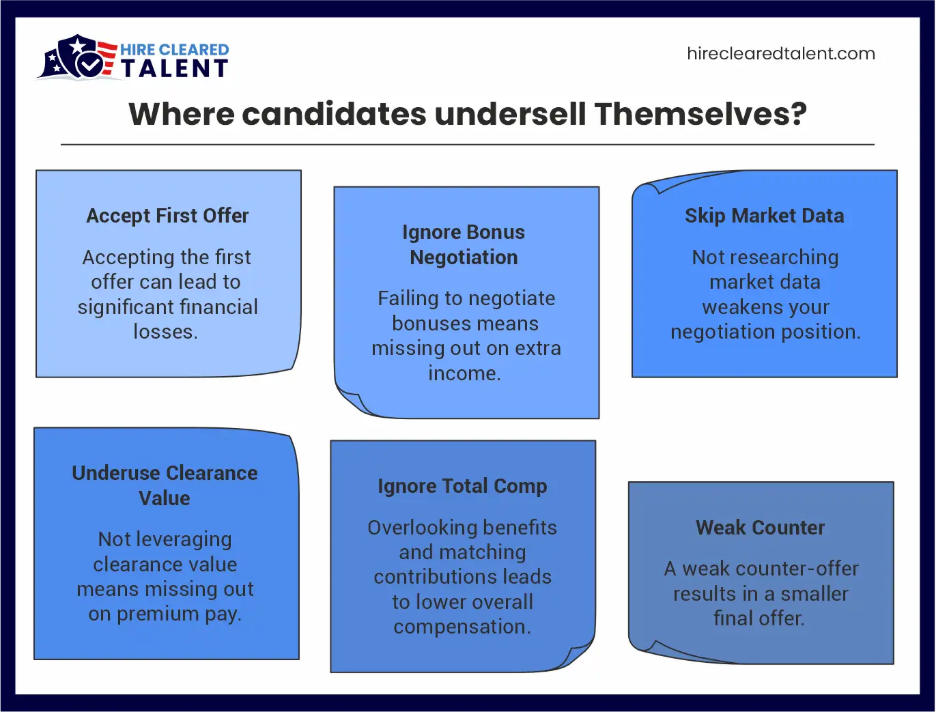
Here’s what most people in this industry don’t say out loud: 70% of cleared candidates accept first offers without countering, leaving $15K-$25K annually on the table, money that compounds over a 10-year contract career into mid-six figures. Companies bank on military culture’s “don’t negotiate” conditioning. Break it.
Why Cashing Your Clearance Check Feels Wrong?
Ever wonder why pushing for $10K more feels like betraying the mission?
Military pay systems don’t negotiate. O-3s don’t haggle over BAH rates. Civilian contracting does. But the muscle memory sticks. Here’s what most people don’t say out loud: 55% of candidates accept first offers without negotiating, leaving $10K-$20K annually on the table in cleared roles, compounding to six figures over a decade.
Clearance accelerates total comp. Adding Full Scope Polygraph pushes salary to $148,314—a 58.2% premium over Secret clearance. Relocation packages cover cross-country moves to GovCloud-focused hubs.
One number changed everything: $10K.
That gap compounds. Year three, he’s $30K ahead. Year seven, $70K+. His clearance paid for his kid’s college before the contract mentioned tuition reimbursement.
Numbers That Actually Move the Conversation
Base salary represents table stakes. Total comp closes deals.
Cleared IT Salary Benchmarks (2026)
- Systems Admin (Secret): $93,748 avg + $15K sign-on
- Network Engineer (TS): $131,907 avg + 6% 401k match
- CyberSOC Analyst (TS/SCI): $135K-$160K range
- IAM Engineer (TS): $114K avg with Okta exp
Tom sent his counter citing three data points: PayScale mid-career benchmarks, TS/SCI 40.6% premium over Secret, and the contractor’s own postings averaging $8K higher. He asked for $142K base, $18K sign-on, 6% 401k match. They countered at $138K, $15K bonus, 5% match. He took it.
Read more: How to Qualify for Federal Security Clearance Jobs?
When Employers Push Back on Your Data?
But employers resist. “Budget constraints.” “Internal equity.” “Clearance is already priced in.” Recognize the script. Federal IT services firms average 90-100 days to hire cleared talent versus 44 days for civilian IT. That delay burns millions in unstaffed billable hours per billet cycle. He showed Oracle RAC clustering from classified environments mapped to production DBaaS. They found $12K in bonus funding.
So, they need you. Yesterday. When they say “no budget,” ask about sign-on or bonus structure. “Internal equity” means ask for promotion eligibility at 12 months. “Clearance priced in” gets answered with Secret/TS salary deltas from their own comp reports.
A cleared vet we advised faced “final offer” at $119K for a Secret-level DBA role Negotiation isn’t confrontation. It’s translation.
The Contractor Math You Need to Know
Program managers live in burn rates. A $150/hour cleared engineer billet generates $300K annual revenue. Empty for 90 days? $75K lost. Add $50K recruiting costs, $100K clearance transfer if inactive. Total: $225K to fill one seat. They’ll move on salary to avoid that hit.
Contractors lowball early to test resolve, then find money for candidates who push intelligently. Tom’s $128K became $138K because he spoke their language: replacement cost, ramp time, revenue impact.
The Poly Bonus Nobody Sees Coming
TS/SCI with polygraph? Different game. Civilian intelligence agencies pay 20-25% premiums over standard TS/SCI—$148K+ starting for senior analysts. Poly clears the highest-risk billets. Don’t undersell that rarity.
Even Secret holders negotiate from strength. Your clearance compounds with experience. Name both.
Read more: Your Roadmap to a Cleared Career: How to Land & Grow in Security Clearance Jobs
Your Clearance Is Your Marketplace Advantage
You’ve got the clearance. You’ve got the skills. Market data proves your floor. HireClearedTalent gives you the edge- live salary benchmarks filtered by clearance level, role, and years of experience. Our marketplace connects you directly to program managers searching daily by TS/SCI, Secret, or Polygraph requirements.
Build your counter from verified comp data plus your classified STIG experience. Test it against three live postings in your niche. Create your profile to HireClearedTalent where hiring teams find candidates who already speak contract-ese. That’s how Tom went from $128K lowball to $138K total comp with bonus.
Do you want our advisors to walk you through your specific clearance leverage and comp positioning before you counter?
FAQ –
Q1- How does security clearance impact salary negotiations?
A- Security clearance increases your market value because it reduces hiring time and cost for employers. Candidates with active clearance often command higher offers since companies avoid long investigation timelines and onboarding delays.
Q2- How much salary premium does a TS or TS/SCI clearance add?
A- Roles requiring TS or TS/SCI clearance often offer significantly higher compensation compared to lower-clearance or non-cleared roles. The premium depends on role, location, and specialization, with the highest impact seen in cyber, cloud, and intelligence positions.
Q3- Why do employers prefer candidates with active clearance?
A- Active clearance allows immediate deployment on projects. Employers avoid months of processing time and high investigation costs, which makes cleared candidates more competitive and valuable during negotiations.
Q4- What factors matter most when negotiating a cleared role offer?
A- Key factors include clearance level, years of experience, technical skills, tools used, location, and urgency of the role. Roles tied to active contracts often have more flexibility in compensation.
Q5- How should cleared professionals justify a higher salary during negotiation?
A- Use market data, role-specific salary benchmarks, and highlight your clearance status. Emphasize how your readiness reduces hiring delays and supports mission-critical work from day one.
Q6- Do security-cleared candidates negotiate differently than civilian candidates?
A- Yes. Cleared candidates often negotiate around contract urgency, clearance transfer timelines, and project needs. Employers may adjust offers faster to secure candidates who can start immediately.
Q7- What mistakes do cleared professionals make during salary negotiation?
A- Common mistakes include accepting the first offer, not using market data, undervaluing clearance, and failing to highlight specific tools or mission experience tied to the role.
Q8- How does clearance transferability affect compensation?
A- Fully active and transferable clearance increases leverage. Candidates who can move directly into a role without re-investigation often receive stronger offers and faster hiring decisions.
Q9- What role do technical skills play alongside clearance in salary discussions?
A- Clearance opens access to roles, but technical skills determine pay levels. Skills in areas like cybersecurity, cloud, and data analytics significantly increase negotiation power.
Q10- How does location impact salaries for cleared roles?
A- Salaries vary by region, with higher pay in areas like Washington, D.C., Northern Virginia, and Maryland due to demand for cleared talent and cost of living.