
Preparing for Interviews in Security Cleared Roles: Key Questions

Table of Contents
- The Question They Ask Before They Ask Anything Else
- The Compliance Questions That Separate You From The Pack
- The Behavioral Questions Nobody Prepares For
- The Technical Questions With Clearance Traps
- The Salary Trap They Set Three Different Ways
- The Program-Specific Questions Nobody Sees Coming
- The Questions About Handling Pressure
- The One Question That Reveals If You’re Cleared or Faking It
- What They Don’t Ask (But Should)
- FAQ –
Matt stared at the email from the recruiter. Six years with an active Secret clearance. Three years hardening networks on a DoD contract. He’d crushed the technical screen—STIG checklists, ACAS scans, the works. Now this: “Tell me about a time you identified a compliance gap during a security audit.” His mind blanked. He’d run audits. Fixed vulns. Never thought about framing it their way. The interview was Wednesday. Matt had 48 hours to figure out how cleared hiring actually worked.
You’ve been there. Or you will be. Cleared interviews aren’t commercial IT screeners. They’re not uncleared federal panels. Wrong answer, or no answer, doesn’t just kill the interview. It costs you six figures and a year waiting for the next slot. We’ve watched this across thousands of cleared pros at HireClearedTalent. And we know the questions they ask. Here’s what you need before you walk into that room.
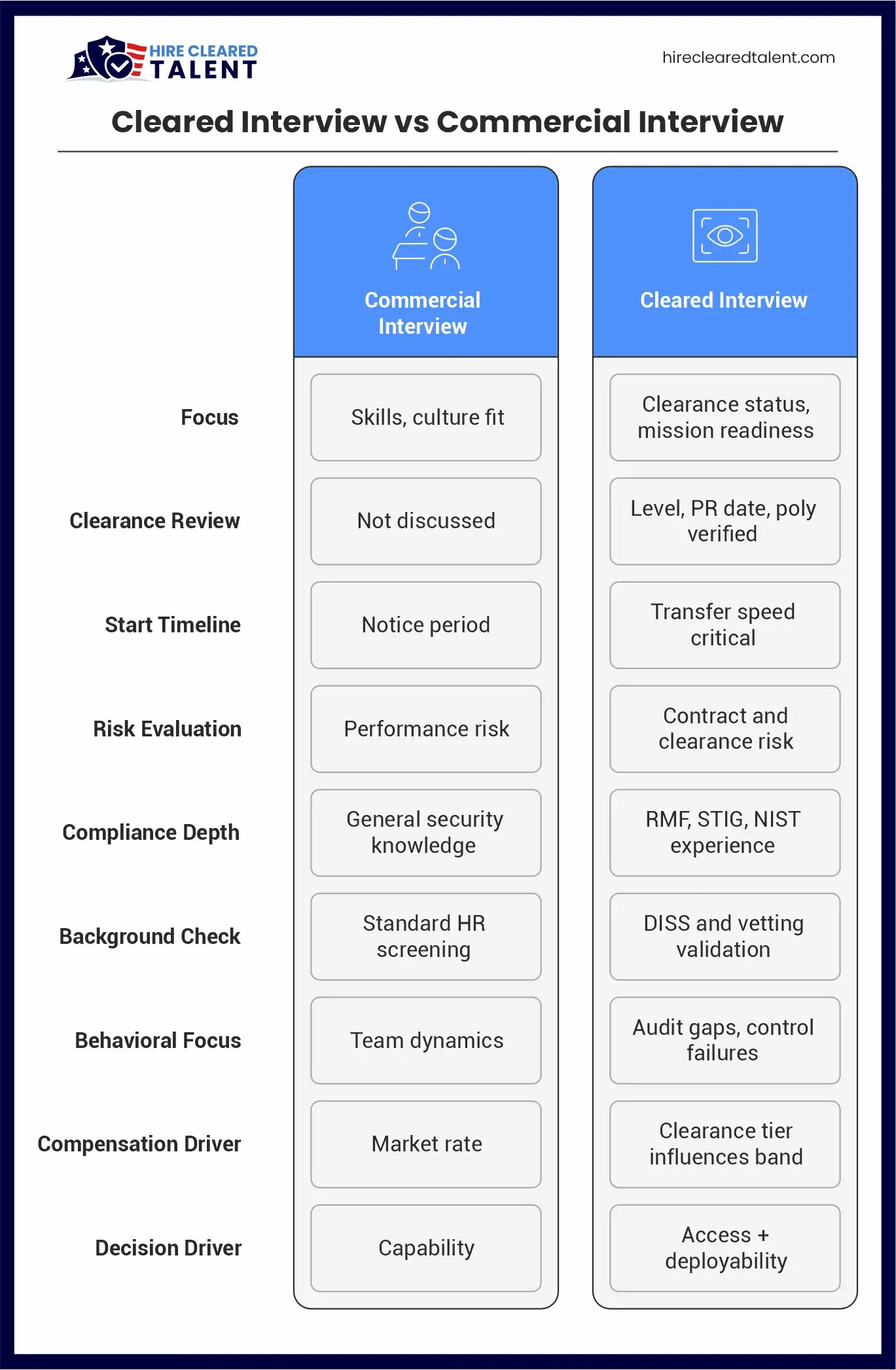
The Question They Ask Before They Ask Anything Else
“What’s your current clearance status?”
Don’t say “Secret” or “TS.” They want the full picture. Active or lapsed? Last PR date? Continuous vetting flags? SCI accesses current? Counter Intelligence poly? Full-scope lifestyle poly?
Your clearance is your resume. A TS/SCI with current accesses beats a PhD every time. But a Secret lapsed 24 months? Bottom of the pile. Contractors won’t sponsor full reinvestigation unless you’re C-suite.
Matt fumbled this one. “Secret. 2021 PR.” Room shifted. They knew, and he knew, that meant 6-12 months before start. Rest of interview was formality.
Answer right: “Active Secret, PR March 2023. No CV flags. Current DISS reporting.” Lapsed? Own it: “Secret 2022, inactive 19 months. Ready for full reinvestigation, happy to start uncleared during processing.”
But here’s the part nobody talks about: They’ll check your JPAS/DISS status before you leave the parking lot. One red flag, unreported foreign travel, late financial disclosure and your offer’s DOA. Seen it happen to 20-year vets.
The Compliance Questions That Separate You From The Pack
“Walk me through a CUI spill response.”
Not hypothetical. NIST 800-171 muscle memory test. They want sequence: isolate, report, document, mitigate. Friday 2 p.m. steps.
“Disconnect system from network. FSO notification within 24 hours per DFARS 7012. Spill form documentation. IR team forensics. Mitigation per SSP.”
Don’t stop. Risk assessment: “SPARTA matrix for classification/exposure impact. Brief leadership on containment vs. disclosure costs.”
A systems admin we placed nailed this for Secret helpdesk. Walked DFARS reporting tree. Got offer. Next guy said “call IT.” Still unemployed.
DFARS 7012 violations? $100K+ remediation. They don’t hire guessers.
“What’s your CMMC Level 2 assessment experience?”
DoD issued 4,731 CMMC RFIs in 2025. Answer: “800-171 is 110 baseline controls. CMMC Level 2 is self-assess or 3PAO. Level 3 adds 24 FAR requirements, government assessment. Level 3 fail = no DoD contracts.”
Matt blanked. Never passed first round.
The Behavioral Questions Nobody Prepares For
“Describe foreign travel triggering security incident report.”
You travel. Toronto family. Dubai conference. They want proof you’ll report—not because you’re shady, but because you know rules.
“Black Hat Vegas, Frankfurt layover. JPAS travel report 30 days prior, carried LOA, FSO report within 5 days return. Clean.”
No travel? “No foreign travel. Current FSO protocols. Last teammate Mexico filed SIR via DISS within 24 hours return.”
Clean record hurts. They want battle-tested compliance, customs agent asking papers, hotel WiFi you skip, “random” security check that wasn’t random.
“Time you disagreed with your FSO?”
Boundaries test. “FSO delayed foreign travel brief. Cited 30-day JPAS rule, showed contract clause. Filed on time. No issues.”
Know regs without being jerk.
Read more: How to Qualify for Federal Security Clearance Jobs?
The Technical Questions With Clearance Traps
“Secure SAP information system?”
Engineers say STIGs/ACAS. Wrong emphasis. SAP isn’t “really classified.” Different beast.
“SCIF hardening beyond TS. Dual-person integrity. TEMPEST shielding. Media sanitization per SAP manual. Two-person activity logs. Weekly FSO audits.”
They nod. You’ve done it.
“Difference between JPAS, DISS, and eQIP?”
“JPAS = old join personnel adjudication system. DISS = Defense Information System for Security, current standard. eQIP = Electronic Questionnaires for Investigations Processing, SF-86 submission platform.”
Uncleared engineers miss this. Cleared pros don’t.
Network segmentation question disguised as clearance test: “How would you isolate CUI from unclassified networks?”
“Cross-domain solutions or air-gapped VLANs. One-way transfer guards. CAC/PIV authentication on all jumps. ACAS scans both sides weekly.”
The Salary Trap They Set Three Different Ways
Never “What’s your number?” Always:
“Financial expectations?“
Cleared salaries averaged $114,956 in 2024, up 6% YoY. Certifications add $7K (2024 Security Clearance Compensation Report). TS/SCI = 18-25% Secret premium.
Answer: “Current $128K base, 8% bonus. Targeting $145K total for SCI access/program responsibility. Published range for this billet?”
Don’t flinch. They budgeted TS/SCI money.
82% of federal contractors report cyber hiring delays due to clearance processing (CCS Global Tech). Your interview determines if they wait 6 months, or move on.
The Program-Specific Questions Nobody Sees Coming
“Black program environment experience?”
Not on LinkedIn. Can’t Google. 24/7 SCIF life. Poly every two years. No work talk with spouse.
“Three years TS/SAP. Two-person integrity classified actions. Current readboards. TSCM sweeps, COMSEC duties.”
No? “Uncleared TS only. Black program orientation last transition. Know access protocols, custody requirements.”
“CI poly versus full-scope lifestyle poly?”
“CI = Counter Intelligence scope. Full-scope = lifestyle + CI. Full-scope fails more often—financials, drug history, sexual behavior. CI agencies accept lifestyle polys. DoD often doesn’t.”
The Questions About Handling Pressure
“Time you worked 80-hour weeks to meet classification deadline?”
Cleared life. “Q4 2023, SAP deliverable. 18-hour SCIF days. Coordinated two-person relief shifts. Hit deadline. No errors.”
“How do you handle FSO-mandated security stand-down?”
“Full team retraining. Phishing sims. Re-certify all read-ins. Resume operations after FSO sign-off.”
The One Question That Reveals If You’re Cleared or Faking It
“What’s a TEMPEST sweep and when do you need one?”
“EM radiation testing for classified systems. Required when SCIF construction completes, after equipment upgrades, or suspected compromise. Annual for SAP environments.”
Most engineers: “What’s TEMPEST?” You’re done.
Read more: How to Recruit Cleared Talent Faster: A Practical Playbook for 2026
What They Don’t Ask (But Should)
Continuous vetting questions. “Any unreported foreign contacts?” They’ll check DISS anyway.
Lifestyle poly prep. Full-scope asks about debt, drugs, sexual history. They’ve flagged you before you answer.
Access read-in specifics. “Which SAP caves have you been read into?” Program-specific. Wrong answer = no offer.
After You Answer: The Real Test
Handshake. “We’ll be in touch.” Silence. Or polygraph you didn’t see coming.
What now?
HireClearedTalent matches your exact clearance profile upfront. TS/SCI + CI poly? We have the billet. Secret + CMMC Level 2? Found it. No clearance surprises. No chasing ghosts.
Create your profile today. Skip recruiter games. Find cleared roles matching your status Day 1. Want to know which programs fit your clearance + experience because cleared hiring rewards those who know the game?
FAQ –
Q1: What clearance details should I be ready to discuss in a cleared interview?
A: Be prepared to state your exact clearance level, status (active or inactive), last investigation or PR date, SCI eligibility, polygraph type, and whether you are enrolled in continuous vetting.
Q2: How should I answer “What is your current clearance status?”
A: Provide a complete response. Include level, adjudication date, and any active accesses. Avoid one-word answers like “Secret” or “Top Secret.”
Q3: Will hiring managers verify my clearance during the interview process?
A: Yes. Most cleared employers verify eligibility in DISS or equivalent systems before extending an offer. Any discrepancies will surface quickly.
Q4: How do I explain a lapsed clearance in an interview?
A: Be direct. State when it became inactive, whether it is within the 24-month transfer window, and whether you are open to sponsorship or interim uncleared work.
Q5: What behavioral questions are common in cleared interviews?
A: Expect questions about audit findings, compliance gaps, incident response decisions, and how you handled classified environment constraints.
Q6: How should I frame audit or compliance experience?
A: Use a structured approach. Describe the environment, the gap identified, the corrective action taken, and the measurable result.
Q7: Do cleared interviews focus more on technical skills or clearance eligibility?
A: Both matter. Clearance eligibility gets you considered. Technical and mission alignment determine selection.
Q8: What role does polygraph status play in hiring decisions?
A: Poly type can significantly affect competitiveness. Full-scope or CI polygraph holders may move faster into roles requiring those accesses
Q9: How do I prepare for mission-specific questions?
A: Review the program’s technical stack, compliance frameworks, and classification level. Align your past experience with similar environments.
Q10: What happens if there is a clearance issue after the interview?
A: Offers can be delayed or rescinded if verification reveals unreported travel, financial issues, or outdated adjudication.