
Remote vs. On-Site Cleared Roles: The Real Choice Every Cleared Professional Faces

Table of Contents
- The Classified Work That Never Leaves SCIFs
- Clearance Maintenance: Active or Dying?
- Compensation: What You Actually Pocket
- Career Growth: Where Real Opportunities Live
- Flexibility: Classified Reality Crushes Promises
- Family Impact: The Hidden Decider
- Strategic Timing: When Each Choice Wins
- Continuous Vetting: The New Clearance Reality
- The Actual Decision Matrix
- Long-Term Compounding Effects By Year
- Cut Through Job Board Bait-and-Switch
- FAQ –
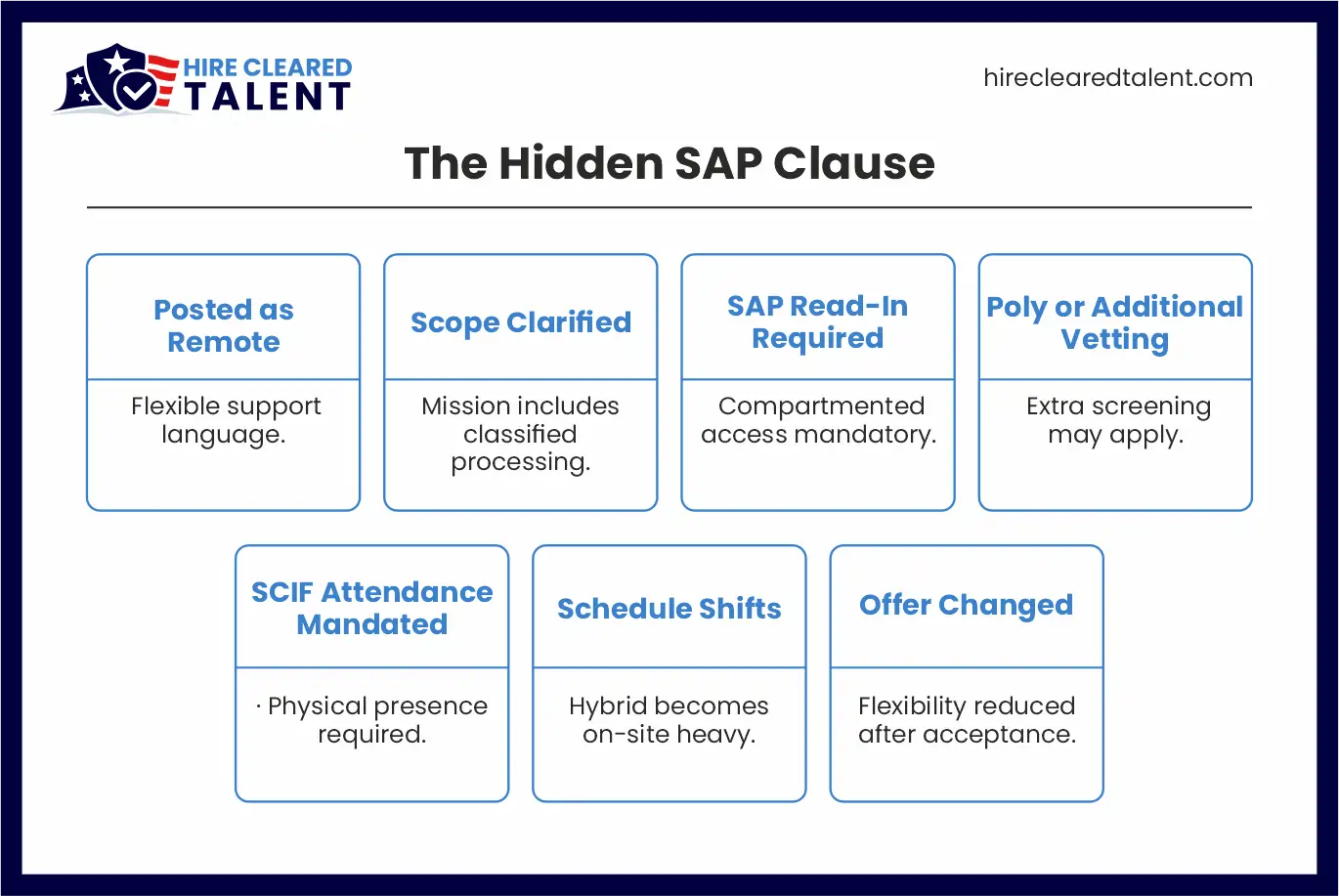
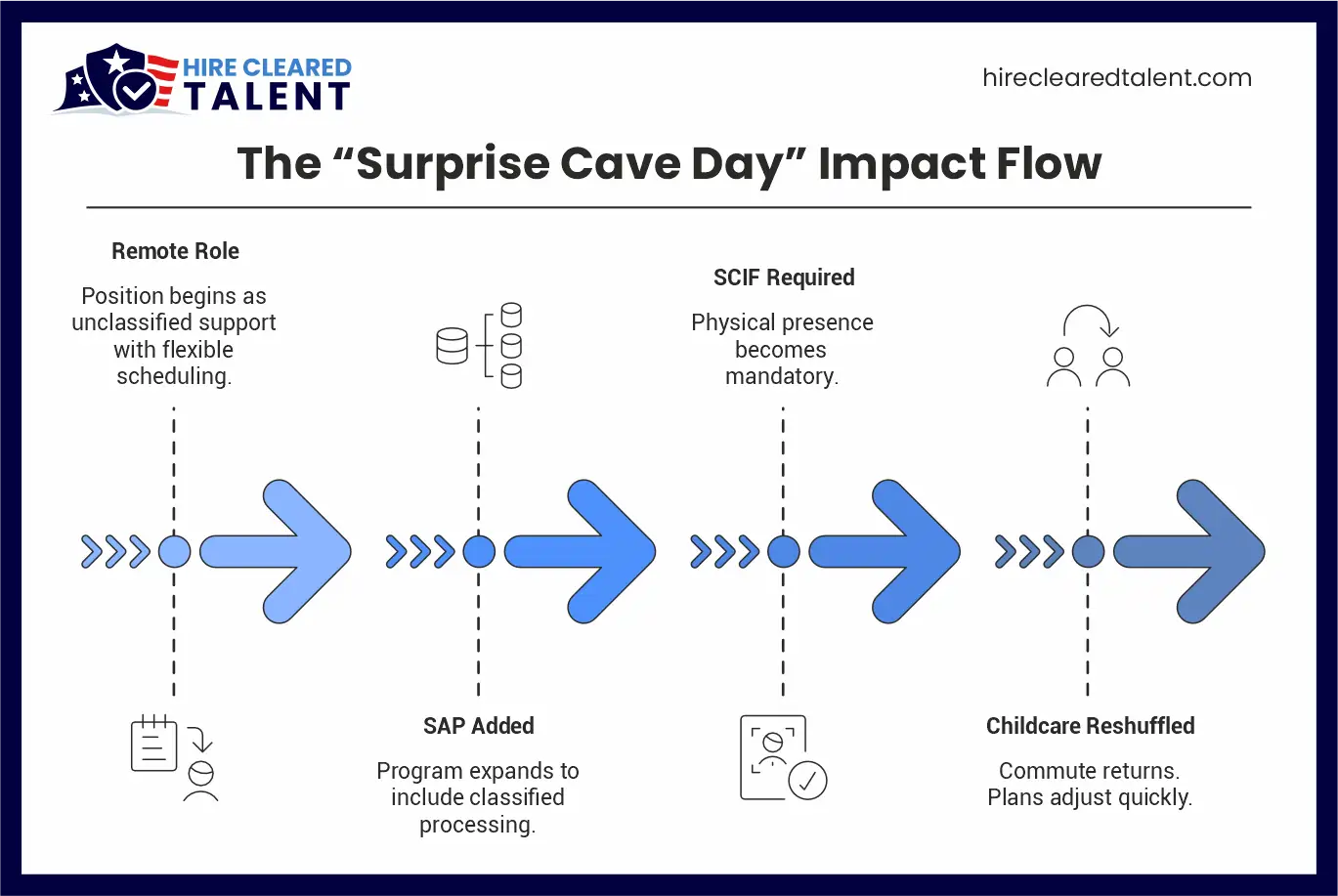
Sarah saw the posting Tuesday night. TS/SCI cyber analyst. $142K total comp. “Remote” in bold. No commute from her Virginia townhouse. She’d hit soccer games. Perfect setup. Applied immediately. Week three: “SAP read-in requires SCIF presence. Tuesdays-Thursdays. Indefinite duration.”
Two hours each way returned with a vengeance.
Every cleared pro faces this fork. Remote postings multiplied after 2020. Most deliver less than promised. We’ve tracked thousands making these calls at HireClearedTalent. Family time gained, career access lost. Cave eligibility maintained, burnout secured. Here are the actual mechanics – no theory, just what plays out daily.
The Classified Work That Never Leaves SCIFs
Remote Reality: Unclassified Support Only
VPN won’t process classified data. Ever. Remote cleared roles handle NIPRNet scans, compliance docs, email triage, public reporting. Legitimate work. But classified systems stay physically secured behind green doors. Sarah’s “remote” role covered unclassified analysis. SCIF days emerged week three. Nobody flagged this pattern during interviews.
What you actually do: ACAS scans on unclass systems. CMMC Level 2 documentation. Draft SIPRNet briefs from NIPR. All solid. Zero classified processing.
On-Site Reality: Daily Green Door Time
TS/SCI billets mean 40-60 hours weekly in SCIFs. SAP programs run two-person integrity shifts, you don’t leave until relief arrives. Daily cave access logs. TEMPEST sweeps monthly. COMSEC duties rotate. Predictable classified processing from 7:30 a.m. to 4:15 p.m.
Daily on-site flow: Badge through three checkpoints. Phone secured in locker. Two-person entry established. Classified work until FSO exit check. No internet. No personal devices. Cave time logged in DISS.
Your choice draws the line: unclassified remote vs. classified cave access.
Clearance Maintenance: Active or Dying?
Remote Risk: Technical vs. Practical Eligibility
Remote unclassified keeps clearance “active” on paper. Zero SCIF time means expired read-ins. SCI compartments lapse after 12-18 months. Hiring managers see “inactive 18 months” in DISS and skip to next resume. Continuous vetting flags pile up—unreported foreign travel, late financial disclosures.
The erosion timeline:
- 3 months: No cave access logged
- 6 months: SCI eligibility questionable
- 12 months: Program managers assume lapsed
- 24 months: Full reinvestigation required
On-Site Advantage: Battle-Ready Access
Weekly readboards signed. Polygraph waivers current. FSOs know your face and compliance habits. Counter Intelligence polygraph stays green. SAP cave accesses accumulate. Hiring managers see “active TS/SCI, current SAP read-ins” and prioritize you.
Industry truth nobody voices: Remote cleared work starts clearance death spiral. Sarah hit 14 months remote. Next TS/SCI interview: “When was your last cave access?” Silence. Clearance “active” technically. Market value zero
Read more: How to Recruit Cleared Talent Faster: A Practical Playbook for 2026
Compensation: What You Actually Pocket
Remote Pay: Commercial IT Ceiling
$110K-$130K range. No SCIF premium. No mission sensitivity differential. Certifications lapse unnoticed—Security+, CySA+ expire without pressure.
On-Site Pay: Premiums That Compound
Cleared professionals averaged $114,956 total comp in 2024, up 6% year-over-year per ClearanceJobs 2024 Compensation Report. TS/SCI adds 18-25% over Secret billets. SAP routinely $160K+. Certifications boost another $7K annually.
The Commute Math That Kills Remote: Sarah’s $142K “remote” netted $118K after two-hour-each-way reality. Gas: $800/month. Vehicle wear: $1,200/month. Backup childcare: $600/month. On-site $155K stayed $155K—plus preserved cave eligibility justifying that premium.
Long-term compounding: Year 3 on-site TS/SCI reaches $175K+ with program lead duties. Year 3 remote analyst caps at $128K individual contributor.
Career Growth: Where Real Opportunities Live
Remote Limitation: Teams Avatar Existence
You’re square #7 on Teams. No hallway conversations post-classified briefings. No “coffee after read-out” moments spawning sponsorships. Surge work lacks cave visibility to program managers.
What you miss: FSO recommending you for SAP lead. TSCM tech sponsoring your next billet. Late-night cave shifts where real talent gets spotted.
On-Site Acceleration: SCIF Networking Power
Program managers identify 2 a.m. surge performers. FSOs remember who handles security stand-downs without resentment. TSCM technicians become quiet sponsors for larger billets. Growth flows through cave access and face time.
A senior systems engineer chose remote for family demands. Logical short-term. Two years later: expired CI polygraph, lapsed SCI eligibility, $108K Secret work. Family presence gained. Career ceiling destroyed.
Flexibility: Classified Reality Crushes Promises
Remote Myth: Freedom Until SCIF Summons
2 a.m. unclassified surges morph classified overnight. “Flexible schedule” becomes mandatory Tuesdays-Thursdays. Sarah expected soccer practices. Reality delivered sudden SCIF trips defying all calendars.
Remote unpredictability: Morning coffee at 8 a.m. 2 p.m. email: “SCIF required tomorrow.” Childcare scrambles. Spouse repositions work.
On-Site Truth: Predictable Cave Grind
7:30-4:30 cave shifts. Weekends free unless two-person coverage mandates otherwise. No midnight Teams pings from leads assuming home availability. Grandparents know the cave schedule.
Family Impact: The Hidden Decider
Remote Tradeoff: Present but Tethered
Here for school pickup. Tied to surge deliverables 24/7. Backup childcare still needed for surprise cave days.
On-Site Tradeoff: Predictable Absence
Dinner alone three nights weekly. Known SCIF schedule allows planning. Grandparents on speed dial for cave shifts.
When your four-year-old needs emergency pickup, can you exit mid-SCAF shift? FSO lockdown secures you behind green doors while others handle parenting.
Secret clearance processing averages 138 days per DCSA Q4 FY2024 data. On-site preserves market eligibility. Remote risks obsolescence.
Read more: How to Qualify for Federal Security Clearance Jobs?
Hybrid Cleared: Separating Fiction from Function
The Recruiter Bait: True Hybrid Classified
Classified processing prohibits true hybridization. “Hybrid cleared” postings lure TS/SCI talent into unclassified support traps.
Legitimate Cleared-Adjacent Flex
- NIPRNet engineering: Unclassified systems, occasional SCIF coordination
- Public CMMC documentation: Level 2 reporting, remote viable
- Contract administration: Bid support, travel coordination, schedule control
All viable. All lower trajectory than cave access.
Strategic Timing: When Each Choice Wins
Remote Delivers Value Here
- Early-career Secret billets building certs (Security+, CCNA Security)
- Family crisis bridge maximum 18 months
- Unclassified IT support, CMMC documentation only
On-Site Dominates Career Phases
- TS/SCI maintaining cave eligibility
- Mid-career acceleration critical
- SAP/program management trajectory targeted
- Financial security outweighs time freedom
Smart sequencing: Network engineer logged 18 months remote CMMC work. Maintained employability. Bridged strategically back to on-site TS/SCI.
One sentence. On-site builds trajectory. Remote prioritizes family immediacy.
The Full SCIF Day Nobody Details
6:45 a.m. Compound Arrival
Three checkpoints. Badge scans. Vehicle search random days.
7:15 a.m. SCIF Entry Protocol
Phone locker secured. Two-person integrity established. No personal devices permitted.
7:30 a.m.-4:00 p.m. Classified Processing
Cave access logged. TEMPEST-compliant systems only. Weekly FSO audits. COMSEC material custody.
4:15 p.m. Exit Procedures
Equipment sanitization verified. FSO accountability signed. Cave hours logged DISS.
Remote contrast: 8 a.m. coffee. 2 p.m. “SCIF required tomorrow.” Instant life repositioning.
Continuous Vetting: The New Clearance Reality
Foreign contacts flag instantly through automated DISS checks. Mortgage denial triggers financial review. Unreported Toronto family visit prompts termination hearing.
On-site advantage: FSO relationships resolve issues discreetly. Program managers provide context.
Remote disadvantage: Faceless DISS entry handled by distant security clerks.
The Actual Decision Matrix
| Factor | Remote | On-Site |
| Clearance Status | Technically active, practically stale | Cave-ready, program current |
| Compensation | $110-130K commercial ceiling | $145-160K+ TS/SCI premium |
| Career Ceiling | Individual contributor track | Program lead opportunities |
| Family Time | Present, surge-tethered | Predictable absence |
| Flex Predictability | Unclassified surprises | Structured cave schedule |
| Networking | Teams avatar existence | SCIF relationship capital |
| Clearance Erosion | 12-18 months to obsolescence | Active access compounding |
Sarah chose remote seeking family balance. Forfeited SCI eligibility. Returned to $105K Secret work. Gained presence. Lost momentum.
Long-Term Compounding Effects By Year
- Year 1 Remote: Clearance active. No cave logged. $128K analyst.
- Year 2 Remote: SCI lapsed. CI poly expired. Secret billets only.
- Year 3 Remote: $25K annual premium lost. Individual contributor ceiling.
- Year 1 On-Site: TS/SCI current. SAP read-ins accumulate. $155K base.
- Year 3 On-Site: Program lead duties. $175K+ trajectory unlocked.
Cut Through Job Board Bait-and-Switch
HireClearedTalent surfaces classified requirements before you apply. TS/SCI cave access mandatory? Listed explicitly. Unclassified remote support only? Clearly marked. Zero post-offer shocks.
Create your profile and match precisely against clearance status, family constraints, career phase. Eliminate recruiter fiction.
Cleared hiring rewards those who understand tradeoffs clearly. Not job board illusions. Need more clarity?
FAQ –
Q1: Are fully remote roles realistic for security-cleared professionals?
A: Fully remote roles are limited in the cleared space because classified work requires access to secure facilities. Most TS/SCI roles require SCIF access, which cannot be performed from home.
Q2: Why do many cleared cyber roles still require on-site presence?
A: Classified networks, secure systems, and sensitive data are physically housed in controlled environments. Access policies require work to be performed inside accredited facilities.
Q3: What types of cleared roles are more likely to offer hybrid flexibility?
A: Roles supporting unclassified systems, policy analysis, program management, or cleared support functions with limited classified exposure may allow partial remote schedules.
Q4: Does working remotely affect my clearance eligibility?
A: Remote work itself does not affect eligibility, but extended time outside classified environments can impact transferability and program continuity in certain cases.
Q5: Do on-site cleared roles offer faster career progression?
A: Often yes. Daily visibility inside secure programs can lead to broader mission exposure, stronger sponsor relationships, and faster promotion opportunities.
Q6: How does clearance level impact remote work options?
A: Higher clearance levels such as TS/SCI with polygraph typically require consistent facility access, reducing remote flexibility compared to Secret-level roles.
Q7: Are cleared salaries higher for on-site positions?
A: In many cases, yes. Roles requiring SCI access or polygraph often command higher compensation due to access restrictions and limited candidate pools.
Q8: Can I negotiate remote days in a cleared position?
A: Sometimes. Hybrid arrangements may be possible if portions of the role involve unclassified work, but full remote access to classified systems is not permitted.
Q9: What are the risks of choosing only remote cleared roles?
A: Limiting yourself to remote options may reduce available opportunities, especially in intelligence, cyber operations, and classified engineering programs.
Q10: How do contract requirements influence remote vs on-site decisions?
A: Contract terms often specify work location requirements. If the program mandates SCIF support, employers cannot override that with remote flexibility