
7 Resume Tips for Security Cleared Talent Applying to Federal Jobs

Table of Contents
- Best Resume Tips for Security Cleared Talent
- 1. Your Clearance Belongs at the Top With Details
- 2. Don’t Write a Civilian Resume for a Security-Cleared Job
- 3. Translate Classified Work Without Violating It
- 4. Certifications Aren’t Decoration – They’re Salary Signals
- 5. Show Contract Awareness – Not Just Job Duties
- 6. Mind the Employment Gaps – Clearance Continuity Is Real
- 7. Write for Two Audiences — The Filter and the Program Manager
- The Resume Mistake That Quietly Kills Interviews
- A Quick Reality Check from the Inside
- What This Means for You?
- FAQ –
Mark had held an active TS/SCI clearance for four years when he applied for a senior cyber role supporting a classified program. He had done the work. He understood the architecture. He had even supported the same mission set under a different contract vehicle. The rejection email came fast. “Not selected.” No interview. No follow-up.
He thought it was the clearance. It wasn’t. It was the resume.
If you’re cleared and applying to federal roles, your resume isn’t just a career summary. It’s a compliance document, a keyword filter test, and a hiring manager’s risk assessment tool — all at once. And in the cleared world, small mistakes cost real opportunities.
We see it every day at HireClearedTalent. Strong professionals. Solid clearance status. Years inside SCIFs. But resumes that don’t reflect how security-cleared hiring actually works.
Let’s fix that.
Best Resume Tips for Security Cleared Talent
1. Your Clearance Belongs at the Top With Details
If a hiring manager has to scroll to find your clearance level, you’ve already made this harder than it needs to be.
Put it near your name. Spell it out clearly. Example:
Active TS/SCI | CI Poly | Adjudicated 2023 | DCSA
That last part matters. Adjudication date tells the employer whether your investigation is current. According to the Office of the Director of National Intelligence’s 2024 annual report, average Top Secret processing time still sits above 130 days. Contractors don’t want to restart that clock unless they have to.
And if your SCI eligibility isn’t active, don’t imply that it is. Misrepresenting access will surface during verification.
2. Don’t Write a Civilian Resume for a Security-Cleared Job
Cleared hiring isn’t the same as commercial tech hiring. The resume format reflects that.
Federal and cleared contractors often expect:
- Month/year employment dates.
- Contract names or program descriptions (when unclassified).
- Clearance level held during each role.
- Specific systems, networks, or environments supported.
We’ve watched candidates lose traction because their resume said “Supported classified network operations.” That’s vague. Instead, write something like:
“Administered Windows Server 2019 environment supporting 300+ users within a TS/SCI enclave.”
See the difference? One sounds like a placeholder. The other tells a program manager you’ve actually been inside the building.
3. Translate Classified Work Without Violating It
You can’t disclose classified details. That’s obvious. But too many cleared professionals swing the other direction and write nothing specific at all.
Think of it like writing through frosted glass. The shape should still be visible.
If you worked on a sensitive analytics platform, you don’t name the system. But you can describe scale, function, and outcome.
Example:
“Led data ingestion pipeline processing 2TB daily across multiple classified sources, improving analyst query speed by 40%.”
Numbers matter. According to the Bureau of Labor Statistics, information security analyst roles are projected to grow 32% through 2032. That demand overlaps heavily with cleared cyber work. Hiring managers want measurable impact, not mission platitudes.
But never include code words, internal program nicknames, or anything that would trigger a security review.
That’s not bold. That’s careless.
4. Certifications Aren’t Decoration – They’re Salary Signals
Security-cleared compensation isn’t just about access. It’s about skill proof.
The 2024 Security Clearance Compensation Report found that cleared professionals holding at least one certification earn on average about $7,000 more annually than those without. That gap shows up in offers.
List certifications clearly. Include version and year earned.
“Security+ (SY0-601) – 2023” tells a reviewer it’s current.
“Security+” alone raises questions.
And if it’s expired, either renew it or remove it. Hiring managers do check.
5. Show Contract Awareness – Not Just Job Duties
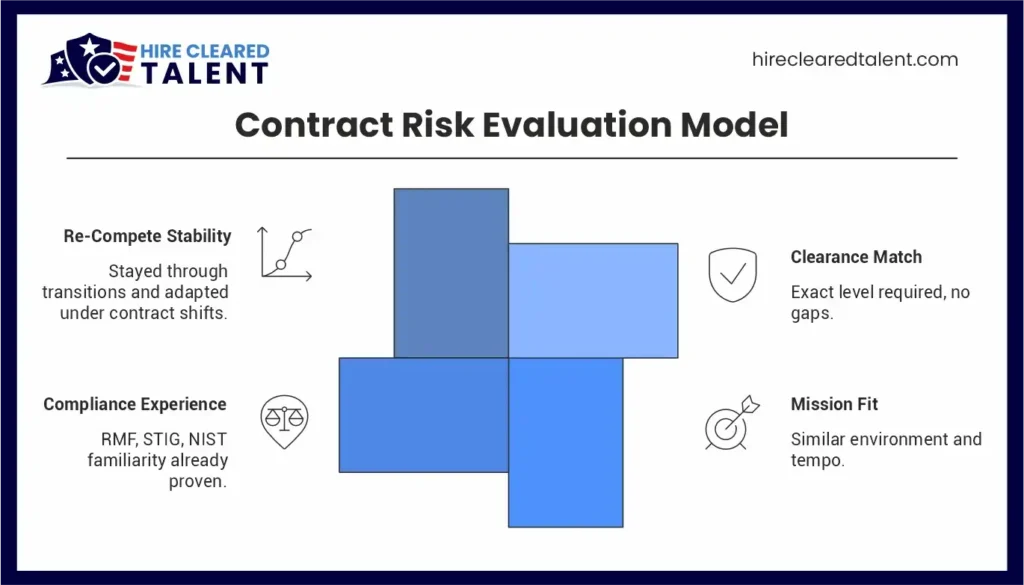
Here’s something most people in this industry don’t say out loud: hiring managers read your resume looking for contract risk.
The honest answer, after two decades of watching this play out, is that cleared hiring isn’t just about your capability. It’s about whether bringing you onto a program creates onboarding friction. If your resume doesn’t show similar contract environments, same clearance tier, similar mission set, comparable compliance frameworks, you look like a ramp-up cost.
That’s uncomfortable. It’s also real.
If you supported a five-year DoD contract with 24/7 operational tempo, say that. If you transitioned through a contract re-compete and stayed on, highlight it. That shows stability and adaptability in a space where contracts end, and rebid cycles create chaos.
Because they do.
6. Mind the Employment Gaps – Clearance Continuity Is Real
If you’ve stepped outside cleared work for more than 24 months, your clearance likely isn’t transferable without new sponsorship. That’s not opinion. That’s how reciprocity windows function.
Public reporting from the Government Accountability Office has documented ongoing backlog pressures in the clearance system. Sponsors are cautious. They prefer candidates whose eligibility can transfer cleanly.
So address gaps directly.
Example:
“May 2022 – August 2023: Commercial Cloud Architect (Clearance inactive during this period; prior TS adjudicated 2021).”
Transparency builds trust. Silence creates doubt.
And doubt slows hiring.
7. Write for Two Audiences — The Filter and the Program Manager
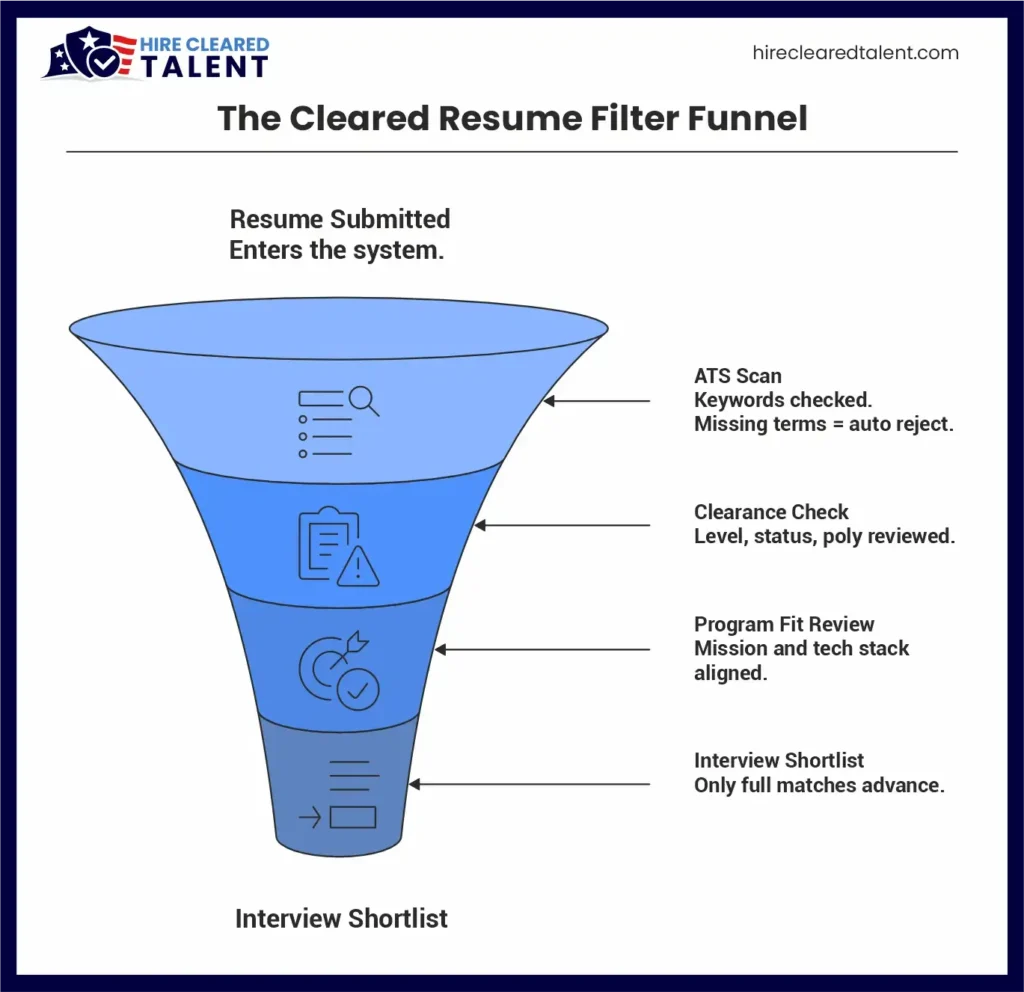
Your resume passes through at least two gates:
- Automated keyword screening.
- Human review by someone who understands the mission.
If a role requires “RMF,” and your resume says “security compliance framework implementation,” you may never reach human eyes.
So mirror the language of the posting. Not mechanically. Accurately.
But don’t stop at keywords. A program manager will scan for specifics:
- Number of users supported
- Network classification level
- Tools and platforms
- Scale of responsibility
One sentence like “Supported enterprise infrastructure” doesn’t move anyone.
A sentence like “Maintained Cisco ASA firewalls within a TS/SCI enclave supporting 1,200 cleared users” does. It reads like someone who’s been inside the wire.
The Resume Mistake That Quietly Kills Interviews
One sentence. No metrics. No systems. No security clearance context.
That’s how many cleared resumes summarize entire roles.
You’ve spent years inside restricted environments. You’ve managed access controls, audit logs, patch cycles, vulnerability scans, and accreditation packages.
And your resume says: “Performed cybersecurity tasks.”
Would you hire that?
Pause there for a second.
A Quick Reality Check from the Inside
Cleared hiring isn’t forgiving. Programs have deadlines tied to funding cycles and deliverables. If a contract starts October 1, and your security clearance reciprocity drags into December, the seat gets filled.
According to reporting on the cleared workforce, over 80% of national security employers report difficulty filling cleared cyber roles (https://www.insaonline.org/insights). That shortage creates opportunity. But only if your resume shows both access and skill alignment.
Otherwise, you’re just another name in a stack of cleared candidates.
Access gets you considered. Positioning gets you selected.
What This Means for You?
Your resume isn’t a biography. It’s a clearance-aligned briefing document.
It should answer, in under 30 seconds:
- What clearance do you hold?
- Is it current?
- What classified environments have you supported?
- What measurable impact did you create?
- How similar is your background to the target program?
If those answers aren’t obvious, revise it.
At HireClearedTalent, we built our platform around the real mechanics of security-cleared hiring — clearance verification, program alignment, and skill matching that reflect how contracts are actually staffed.
If you’re serious about your next move, create your profile on HireClearedTalent. Make your clearance visible. Make your skills measurable. Put yourself in front of roles that match your actual access level.
And if you want direct feedback before you apply again, schedule a call with our experts. We’ll walk through your resume the way a cleared hiring manager would with the friction points in mind.
Because in this space, clarity wins. And your clearance deserves more than a generic resume. Still have confusion? Feel free to connect.
FAQ –
Q1: How should I list my security clearance on a resume for federal jobs?
A: Place your clearance near the top of your resume, close to your name. Include level (Secret, TS/SCI), status (active), adjudication year, and polygraph type if applicable.
Q2: Should I include my clearance investigation date on my resume?
A: Yes. Listing the most recent adjudication or investigation year helps employers assess reciprocity eligibility and onboarding timelines.
Q3: How do I describe classified work without revealing sensitive information?
A: Focus on scope, scale, and measurable outcomes. Mention environments, technologies, and impact, but avoid code words, compartment names, or classified program identifiers.
Q4: Does clearance level matter more than technical skills on a resume?
A: Clearance gets you considered. Technical alignment wins the role. Hiring managers prioritize candidates who match both the clearance requirement and the mission-specific skill set.
Q5: How detailed should employment dates be for cleared positions?
A: Use month and year formatting for each role. Federal and cleared contractors often expect precise timelines to evaluate clearance continuity and contract stability.
Q6: Should I mention contract vehicles or program types on my resume?
A: When unclassified, yes. Referencing mission sets or contract environments helps hiring managers assess risk and onboarding readiness.
Q7: How do employment gaps affect cleared hiring decisions?
A: Gaps longer than 24 months outside cleared work can affect clearance reactivation. Address gaps clearly and explain clearance status during that period.
Q8: Do certifications increase my competitiveness in cleared federal roles?
A: Yes. Technical certifications signal current expertise and often correlate with higher compensation and faster selection in specialized roles.
Q9: How can I optimize my resume for federal contractor applicant tracking systems?
A: Mirror key terms from the job description accurately, especially required tools, frameworks, and compliance standards such as RMF or specific platforms.
Q10: Should my cleared resume be longer than a private-sector resume?
A: Often yes. Cleared resumes typically include more detail on scope, classification level, user base size, systems supported, and contract context.