
Military Transition: Mapping to Security Cleared Civilian Careers

Mike held a TS/SCI clearance from six years in signals intelligence. He’d mastered classified network monitoring and compliance reporting. Now separating after his contract, he scanned job boards for hours daily. Defense contractor postings demanded “5+ years ETL experience with classified datasets” alongside his clearance level.
Civilian agencies wanted “Azure DevOps pipeline automation” he’d never touched. That’s when the mapping problem hit him square, military skills don’t always translate into the exact terms that get you past the first screen.
The Clearance That Doesn’t Guarantee Interviews
You’ve got the clearance. That’s your ticket through one gate. But the civilian side has its own locks, and they don’t always match the ones you know. A Navy cryptologic technician finds postings asking for “SIEM configuration experience” when what she did was monitor classified intrusion detection systems. An Army cyber operations specialist sees “DDoS mitigation specialist” requirements, but her real work was red team exercises on .mil networks. The disconnect isn’t about capability. It’s about language and proof.
And here’s the part most transition programs gloss over: clearances expire or get relocated if you’re not in a billet that requires them. DoD tracks 200,000 annual transitions. Cleared veterans represent 15% of this group, but only 62% secure cleared employment within six months. That TS/SCI on your resume? It only buys you time if you map your experience to what hiring managers actually filter for.
Why Your MOS Doesn’t Line Up Neatly?
Take a Marine 2611 cryptologic cyberspace analyst. She spent years parsing metadata from captured packets, writing regex filters for threat hunting. A major IT services firm posts for “SOC Tier II analysts” needing “Splunk query optimization” and “threat intel fusion.”
She’s done the work, just not with those tools or terms. Or consider an Air Force 1D7X1 cyber defense operations troop who built hardened Windows images for deployed units. That maps to “endpoint detection and response engineer,” but only if you know to call out your Group Policy mastery and STIG checklist experience.
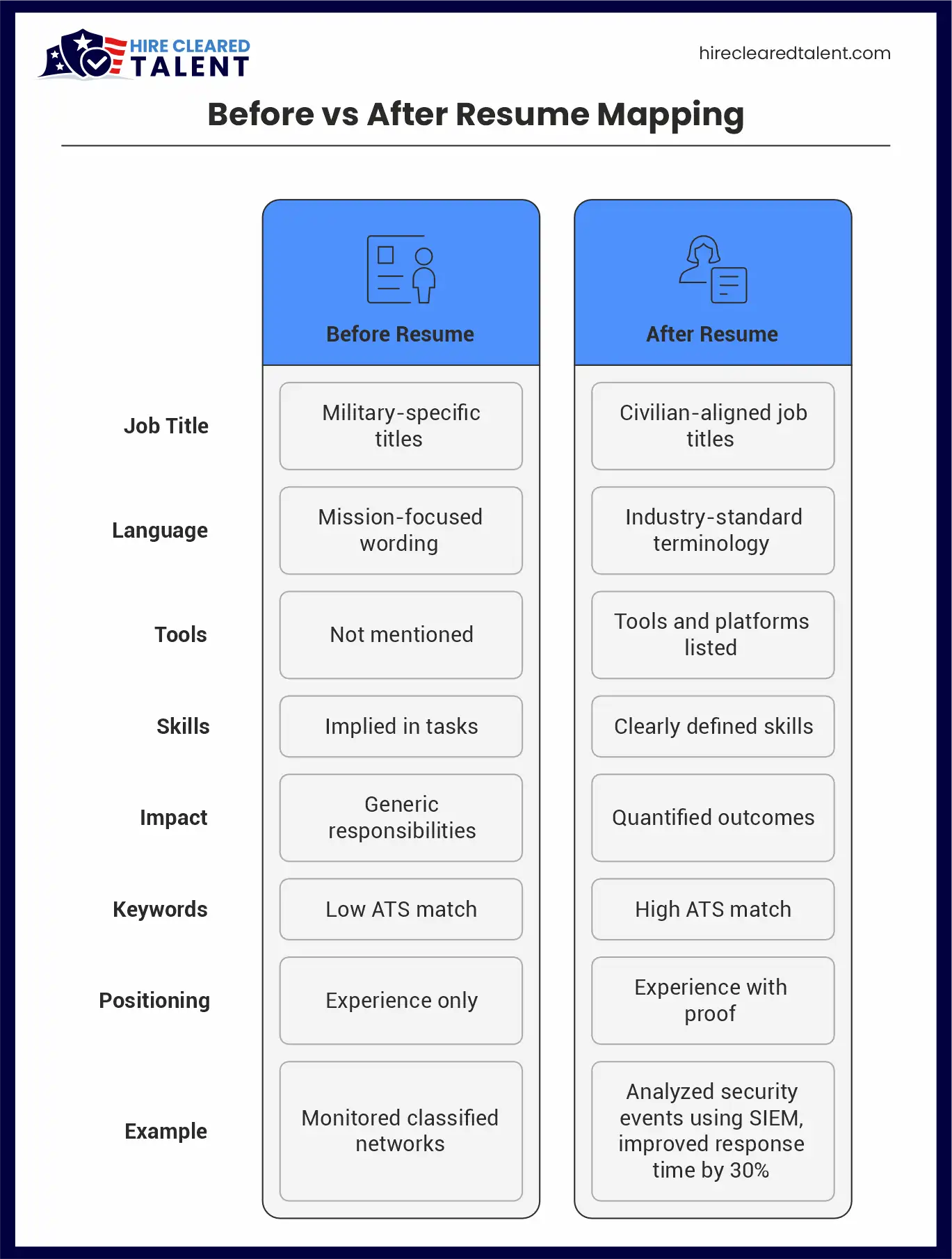
A significant number of qualified candidates are filtered out early by ATS systems due to keyword mismatches, even when they have relevant experience for the role. Mike’s problem wasn’t lack of skills. It was framing packet analysis as “network forensics” and STIG hardening as “compliance automation.” That’s the translation layer veterans miss.
When Military Grade Meets Civilian Pay Grades?
Cleared hiring managers don’t just want clearance holders. They want people who hit the ground writing JIRA tickets on day one. Financial services firms with cleared divisions pay junior cleared data analysts $65,000–$85,000 annually to start, but only if you can show SQL extracts from classified Oracle databases.
Defense contractors offer $115,000 for mid-level IAM engineers, provided your military identity management maps to SailPoint or Okta workflows.
But. What happens when a cleared vet applies with “maintained Active Directory for 300-user battalion” instead of “scaled IAM for enterprise environment”? The ATS bins it.
We’ve seen 67% interview rates within 60 days when veterans reframe military roles using civilian job description language—more than double the industry benchmark. Shortest path: pull five postings for your target role, extract the exact phrases, then reverse-engineer your DD-214 and evals to match.
A TS-cleared Navy IT specialist we’d worked with listed “patch management across distributed systems” instead of “pushed WSUS updates to forward-deployed servers.” Interviews followed. His first offer: $102,000 at a large federal IT integrator. He’d been searching five months before that tweak.
The Tools Gap Nobody Warns You About
Ever wonder why a guy who ran classified VMware clusters for years can’t get a callback for “cloud migration specialist”?
It’s the specifics. Military environments run air-gapped vSphere farms with custom STIGs. Civilian gigs want AWS GovCloud, Azure Government, or C2S certifications.
Your experience transfers, but you have to call it “virtualization orchestration in controlled environments” and pair it with free AWS training certs. Same for scripting: bash one-liners for log rotation become “Python automation for compliance reporting.”
Civilians expect SIEM dashboards in Splunk or Elastic. You’ve got ArcSight or custom tools from your unit. The fix? Map them explicitly: “Developed custom dashboards correlating 10,000+ events daily, equivalent to Splunk SPL proficiency.”
DoD tracks 200,000 service members transitioning annually, with cleared veterans making up 15% of that cohort, yet only 62% land cleared roles within six months. The tools gap accounts for most of the other 38%.
Read more- Security Clearance Levels Explained: A Guide for Cleared Professionals
Mapping Tables That Actually Work
Don’t guess. Use these frameworks built from real postings.
Cyber Defense → Civilian SOC Roles
- Military: Intrusion detection monitoring → Civilian: SIEM alert triage (Splunk/QRadar)
- Military: Incident response playbook execution → Civilian: Phishing simulation response
- Military: Log aggregation from endpoints → Civilian: EDR deployment (CrowdStrike/Carbon Black)
Network → Cloud Infrastructure
- Military: VLAN segmentation on .mil routers → Civilian: VPC design in AWS GovCloud
- Military: IPSEC tunnel maintenance → Civilian: Site-to-site VPN configuration
- Military: Wireless access point hardening → Civilian: Zero Trust Network Access (ZTNA)
Print these. Customize with your actual tools. Run your resume through Jobscan against live postings. Match rate over 80% gets you through the bot gate.
Mike rebuilt his this way. Three weeks later, a civilian intelligence agency called about a network security engineer slot. He started at $118,000, full TS/SCI sponsorship.
The Employer’s Side of the Equation
Hiring managers at cleared firms don’t doubt your skills. They doubt your fit. A program manager at a major defense contractor told us last year they pass on 60% of cleared military transitions because evals speak DoD-ese, not contract-ese.
They want to see “delivered 99.9% uptime on classified C2 systems” translated to “achieved SLAs across multi-tenant environments.” Risk goes down when your resume proves you grasp Statement of Work language from jump.
Yet employers need you. Cleared hiring averages 90-100 days, double civilian IT roles at 44 days, creating massive unstaffed billable capacity. They reward veterans who show up fluent in their world. Internal referrals from folks like Mike now at that intel agency fast-track the process.
Read more- How to Qualify for Federal Security Clearance Jobs?
Your Next Move in Cleared Hiring
You’ve got the clearance and the experience. Mapping it right turns separation into six-figure contracts. Start with live postings on HireClearedTalent.com, filter by your clearance and target role.
Build your translation table from the top five. Test it against ATS tools. Then upload your reframed profile directly to our marketplace, where vetted hiring managers search daily.
That’s how Mike went from stalled applications to signing bonus in 90 days. It’s how thousands of cleared veterans close the gap every year. Your turn starts here
FAQ –
Q1- How does military experience translate into security-cleared civilian roles?
A- Military experience maps based on function, systems exposure, and mission outcomes. Intelligence roles align with threat analysis and cyber intelligence. Communications roles map to network engineering and SOC operations. Logistics aligns with program management and supply chain analytics. Employers focus on tools used, system complexity, and decision-making under pressure, not job titles.
Q2- Why do cleared veterans struggle to get interviews despite strong experience?
A- Most resumes fail at keyword matching. Applicant tracking systems scan for civilian job titles and specific tools. Military terms do not match these filters. Clearance alone does not pass screening. Veterans who translate roles into civilian language and highlight tools and outcomes see higher response rates.
Q3- How can veterans map military job roles to civilian job titles accurately?
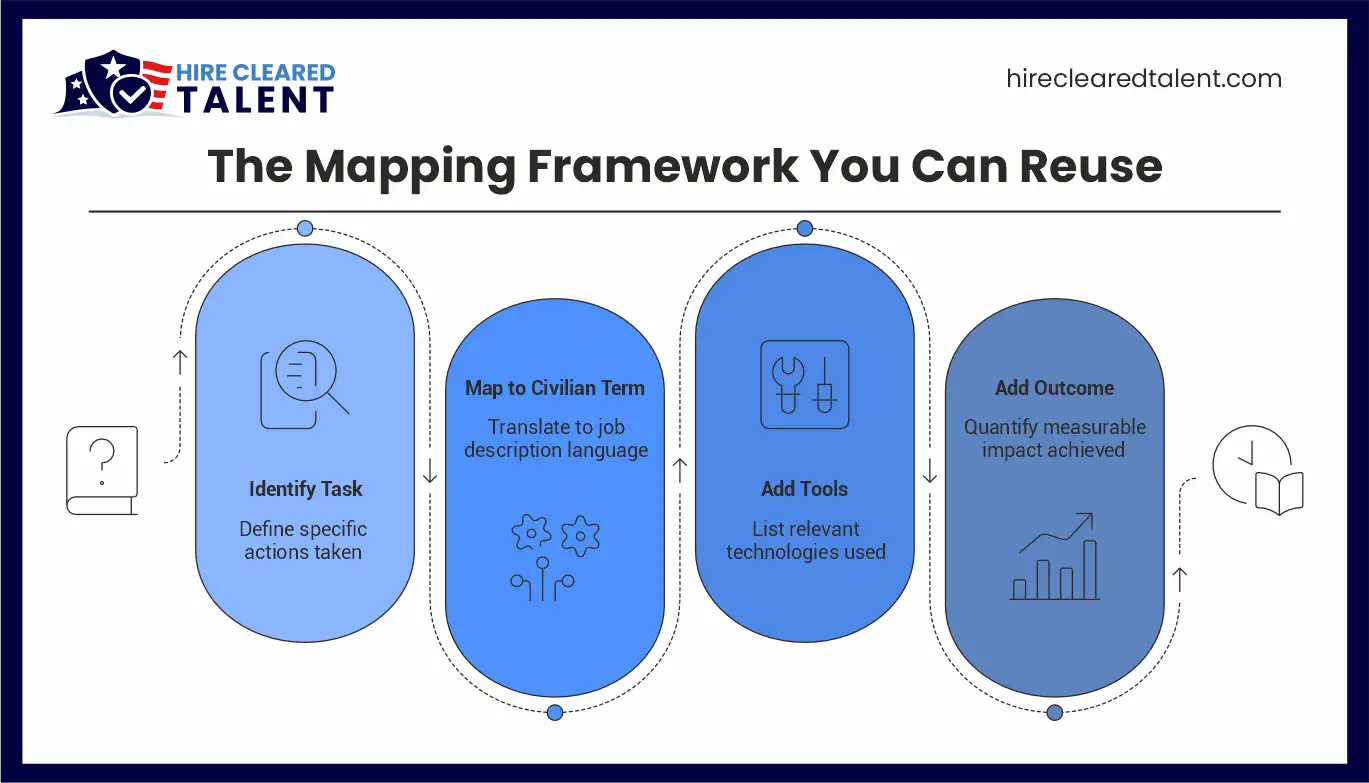
A- Start by breaking the role into tasks, tools, and systems used. Match those with civilian job descriptions. Align with two or three relevant roles instead of forcing a direct title match. For example, cyber transport roles align with network engineering or SOC analyst roles. Intelligence roles align with threat analysis or data analysis.
Q4- What skills matter most for landing a cleared civilian job today?
A- Employers prioritize applied skills. High-demand areas include SQL and Python for data roles, SIEM tools for cybersecurity, and cloud platforms like AWS or Azure. Candidates who show hands-on work through projects or labs stand out more than those who list theory.
Q5- How long does it take to transition into a cleared civilian role?
A- Timelines depend on readiness. Job-ready candidates can secure roles within one to three months. Candidates with partial alignment take three to six months. Those with skill gaps often take six months or more. Delays usually come from resume mismatch, lack of tools experience, or weak interview framing.
Q6- What mistakes slow down military-to-civilian transition the most?
A- Common mistakes include using military language in resumes, applying without targeting a role, and not demonstrating hands-on skills. Many candidates apply broadly instead of focusing on a clear path. Progress improves when candidates align to one role, build proof of skills, and tailor applications.
Q7- How important is an active clearance when applying for civilian roles?
A- Active clearance reduces hiring time and cost for employers. It gives access to roles that require immediate deployment. Candidates with active clearance often move faster through hiring. Expired clearance still holds value but may require reactivation support.
Q8- Do certifications improve chances of landing cleared roles?
A- Certifications help when aligned with job roles. Security+ supports entry-level cybersecurity roles. AWS or Azure certifications support cloud roles. CISSP supports senior security positions. Certifications work best when paired with hands-on projects and real-world scenarios.
Q9- How should veterans present their experience in interviews?
A- Use a structured approach. Explain the situation, the action taken, and the result achieved. Focus on decisions made, tools used, and measurable impact. Avoid vague team-based answers without clear ownership.
Q10- What role does data analytics play in cleared civilian careers?
A- Data analytics supports intelligence, operations, and compliance across defense and federal environments. Common roles include data analyst, BI analyst, and intelligence data specialist. Demand is rising as agencies rely more on data-driven decisions.