
How to Restart Your Cleared Job Search After Job Loss or Contract End?

Table of Contents
- Steps to Restart Your Cleared Job Search
- 1- Know Your Clearance Status Before You Do Anything Else
- 2- Understand the 24-Month Clock in Practical Terms
- 3- Rebuild Your Resume for This Market, Not the Last One
- 4- The Job Board Is the Floor, Not the Ceiling
- 5- Position Yourself as Day-One Ready
- 6- Make a Real Decision About Non-Cleared Bridge Work
- 7- Audit Your Professional Presence Before Recruiters Do
- What HireClearedTalent Does Differently?
- Take the Next Step Right Now
- FAQ –
Losing a cleared position whether through a contract end, a recompete loss, a RIF, or an agency drawdown puts you in a situation that requires a very specific kind of response. Not a general job search. Not a resume refresh and a few LinkedIn applications. A deliberate, clearance-aware restart built around how this market actually operates.
2025 has been disruptive across the cleared workforce. Layoffs and workforce reductions have pushed more qualified candidates into the market at the same time. At the same time, 83% of cleared professionals are open to new opportunities, increasing competition across roles. Federal hiring has also become more selective, with agencies and contractors prioritizing exact skill and clearance alignment over broad qualifications.
But the fundamentals have not changed. Your clearance remains one of the scarcest credentials in the market. There are tens of thousands of open roles requiring cleared professionals, and demand continues to outpace supply in key areas like cybersecurity, cloud, and intelligence operations. Average compensation has reached $119,131, with steady year-over-year growth, reinforcing how valuable cleared talent remains even in a tighter market.
The question is not whether opportunity exists. It does. The question is whether your restart strategy is built to reach it before your clearance window starts to close.
Below is the practical framework to do exactly that.
Steps to Restart Your Cleared Job Search
1- Know Your Clearance Status Before You Do Anything Else
This is not a formality. It’s the foundation everything else rests on.
The 24-month reinstatement window is real, and it’s running from the date of your last day in a cleared role, not from when you started your job search. If your contract ended and your sponsoring organization dropped your clearance before your investigation concluded, your case may have been placed into Loss of Jurisdiction (LoJ) status, which halts the clearance process entirely.
Without an active sponsoring agency, the government stops investigating or adjudicating your case, effectively freezing your ability to appeal or advance, regardless of the underlying merits of your background.
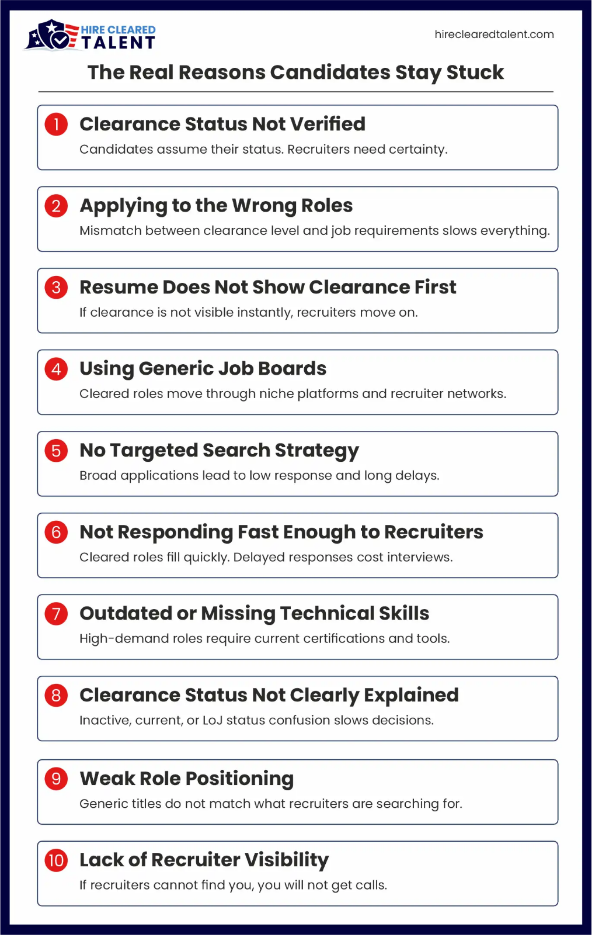
So before updating your resume, before reaching out to recruiters, before anything, confirm exactly where your clearance stands. Contact your former FSO directly and ask for written confirmation of your clearance status.
If you had access to DISS through a prior employer, understand that you may still be able to verify your status through a sponsoring organization’s FSO even after separation. Know the difference between active, current, and inactive because cleared employers make very different decisions based on that distinction, and you need to walk into every conversation knowing your actual position, not a rough approximation of it.
2- Understand the 24-Month Clock in Practical Terms
Most cleared professionals know the 24-month window exists. Fewer understand how it interacts with actual cleared hiring timelines in a way that creates real urgency.
A cleared job search done properly isn’t fast. Identifying the right roles takes time. Getting your profile in front of the right cleared recruiter takes time. First conversations, interviews, offer negotiation, and then the period between offer acceptance and your actual start date with a new sponsoring employer, none of that moves overnight.
Clearance processing timelines in 2025 commonly run 6 to 12 months or more for full approval, which means if your clearance lapses and you need a new investigation, you’re looking at potentially a year or longer of being ineligible for active cleared roles even after a new sponsor is found.
Run the math. If you separated twelve months ago and are starting your search today, you have roughly twelve months before the window closes. A cleared hiring cycle can consume eight to fourteen weeks on the short end under ideal conditions. Factor in role availability, recruiter pipeline, interview schedules, and onboarding timelines and twelve months becomes a tighter runway than it appears.
The professionals who restart their searches the day they separate are not being paranoid. They’re being accurate about the math.
3- Rebuild Your Resume for This Market, Not the Last One
Your clearance level belongs at the top of your resume. Not in the body of a job description. Not abbreviated in a way that requires interpretation. Right at the top, clearly stated: Active Top Secret/SCI | Full Scope Polygraph or Active Secret | DoD Adjudicated or, if applicable, Inactive TS/SCI – Within 24-Month Reinstatement Window.
That last point matters more than most candidates realize. Cleared recruiters can work with an inactive clearance that’s still inside the reinstatement window but only if they understand your actual situation from the first contact. Ambiguity about clearance status is one of the fastest ways to fall out of a cleared recruiter’s consideration before you’ve had a real conversation.
Beyond clearance status, employers in 2025 increasingly prioritized candidates who could be productive from day one meaning program-specific experience, customer familiarity, and immediately applicable skills mattered far more than general qualifications or seniority alone.
Your resume needs to reflect not just what you’ve done but where you’ve done it – the mission area, the program type, the customer environment without disclosing classified details. Cleared hiring managers read resumes differently than civilian HR teams. They’re looking for signal about your operational familiarity, not just your job title history.
For federal positions specifically, the format requirements are different from contractor resumes: longer, more detailed, with explicit duty descriptions, hours per week, and supervisory information included.
The evaluation criteria section in every federal announcement tells you exactly what the agency is weighing. Use that language deliberately in your resume. Not as a generic exercise, but because federal evaluators aren’t inferring fit, they’re matching stated criteria to documented experience, line by line.
Read more- How to Qualify for Federal Security Clearance Jobs?
4- The Job Board Is the Floor, Not the Ceiling
Here’s what most people in this industry don’t say out loud: a significant share of cleared positions get filled before a public posting ever goes live. That’s not a rumor or an excuse, it’s the structural reality of a market where pre-cleared talent is scarce and hiring managers don’t have the luxury of waiting.
When a program loses a cleared resource, the first calls go to the recruiters who placed the last three people on that contract, or to former colleagues who mentioned last quarter that they were keeping their options open.
Cleared recruiters report they no longer place people on interim clearances, they need active clearances and they need them fast, often paying higher bonuses just to compete for candidates who are genuinely rare. That context matters for how you approach your search. A recruiter managing a requisition for a TS/SCI-cleared cybersecurity engineer is not browsing job boards for candidates. They’re working their network and their existing talent pool first.
So, apply to posted roles – yes. But treat that activity as the baseline. Put equal energy into direct recruiter outreach, cleared professional communities, industry events, and former colleagues across every cleared environment you’ve worked in over your career. The relationships you maintained while employed are the fastest path to opportunities that haven’t been posted yet. The cleared market is small enough that a trusted referral from someone who knows your work is worth more than fifty cold applications.
5- Position Yourself as Day-One Ready
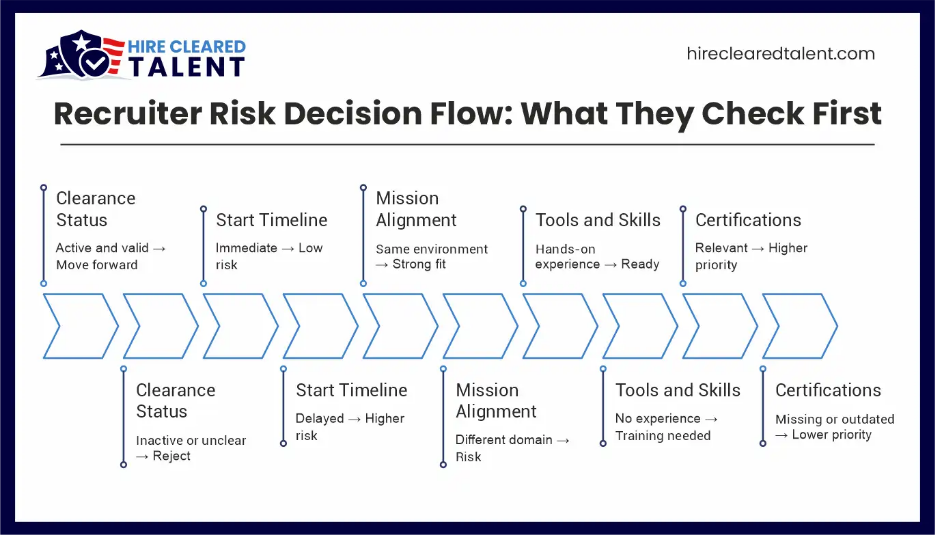
The 2025 cleared hiring market has become more risk-averse on the employer side. Hiring managers favored candidates already familiar with the customer, mission, tools, and workflows because the idea of onboarding someone new felt like a risk many programs were unwilling to take. That’s a real constraint, and it shapes how you should present yourself in every recruiter conversation and interview.
The goal is to eliminate perceived risk. Be explicit about your availability date. Be clear about your clearance status and any factors that could affect your start timeline. Know which customer environments and program types your experience maps to most directly, and lead with that alignment rather than making the hiring manager figure it out.
If your last contract was in a specific mission area – signals intelligence, cybersecurity, financial intelligence, logistics target your search first toward programs in that same space. You’re not just a cleared professional; you’re a cleared professional with specific operational context that most candidates don’t have. That specificity is the differentiator, and it’s worth more than a broad search producing high application volume with low conversion rates.
Certifications also matter more in the current market than they did three years ago. Cleared professionals are increasingly investing in upskilling and certifications to demonstrate skills that transfer across programs, agencies, and sectors particularly in cybersecurity, cloud infrastructure, and DevSecOps, where technical credential requirements have hardened even for roles that previously prioritized clearance level over specific technical proficiency.
6- Make a Real Decision About Non-Cleared Bridge Work
This is the conversation nobody has clearly enough, and it needs to happen early in your restart process not after three months when financial pressure starts affecting your judgment.
Taking a non-cleared role to bridge the income gap is a legitimate option. But it carries a specific and non-negotiable consequence: the 24-month clock keeps running. Taking bridge work doesn’t pause it. And cleared professionals who take non-cleared roles with the intention of continuing their cleared search often discover, six months later, that the cleared search has quietly slowed to a stop because the immediate financial pressure eased.
Set a firm rule before you accept bridge work: keep the cleared search running in parallel as an active priority, not a background project. Know exactly when your 24-month window closes and mark it. Build that date into your planning the same way you’d build a contract end date into a project schedule.
The financial case for holding the cleared search is stronger than many professionals in transition fully internalize. More than 13% of cleared professionals switched employers for better pay in the last year alone, according to the ClearanceJobs 2025 Compensation report reflecting how actively this market is moving and how real the premium for active pre-cleared talent remains. A cleared role in cybersecurity, intelligence analysis, or cloud infrastructure often commands compensation that makes a few additional months of search investment worth the discipline.
7- Audit Your Professional Presence Before Recruiters Do
Cleared recruiters and program managers will look you up before they call you back. What they find matters.
Your professional profile, wherever you maintain one – should reflect your clearance level, your functional background, and your availability status clearly and consistently. It should show program-relevant experience without disclosing anything sensitive. And it should be current – a profile with a last update from two years ago signals, accurately or not, that you weren’t paying attention.
One of the clearest behavioral shifts in 2025 is that cleared professionals started keeping their resumes updated and quietly networking even while employed because passive job searching became a form of professional self-protection, not a signal of disloyalty. If you weren’t in that mode before your separation, now is the time to catch up. An outdated professional presence costs you opportunities you never knew you were in contention for.
Read more- Your Roadmap to a Cleared Career: How to Land & Grow in Security Clearance Jobs
What HireClearedTalent Does Differently?
Restarting a cleared job search is not the same as restarting a civilian job search. The clearance clock, the relationship-driven nature of cleared hiring, the program-specific experience preferences, the distinct resume requirements for federal versus contractor roles, none of that is common knowledge, and none of it is well-served by general employment platforms built for the broader market.
HireClearedTalent is a dedicated hiring marketplace built entirely around the cleared employment space. We connect security-cleared professionals with federal agencies and defense contractors who are actively hiring right now — not through a generic applicant queue, but through a platform designed around how this market actually works.
Our cleared hiring specialists understand the difference between an active clearance, a current clearance, and one approaching the 24-month reinstatement threshold. They know which programs are hiring, which organizations have stable funding going into 2026, and where pre-cleared professionals at your level and with your background are most urgently needed.
When you create a profile with HireClearedTalent, you’re not submitting into a void. You’re getting your clearance status and functional background directly in front of recruiters who specialize exclusively in this market, the people who know about roles before they’re posted, and who prioritize candidates who are positioned clearly and available quickly.
The professionals who recover fastest from job loss or contract end in this market are the ones who got strategic immediately about their clearance clock, their resume, their network, and where they placed their profile. The ones who moved slowly, applied broadly, and waited ended up at month eighteen with a shrinking window and diminishing options.
Your clearance is still your strongest asset in this market. The only question is how quickly and how well you’re deploying it.
Take the Next Step Right Now
Don’t wait until financial pressure compresses your decision-making. The difference between a clean cleared job transition and a stressful one is almost always made in the first two weeks before the urgency builds and options narrow.
Create your free HireClearedTalent profile today. Tell us your clearance level, your functional background, your availability, and what you’re targeting next. Our cleared hiring specialists will work directly with you to match you to active roles that fit with employers who are looking for exactly what you bring right now.
Create Your Profile at HireClearedTalent →
And if you want a direct conversation about your specific situation, your clearance status, your timeline, and the restart strategy that makes the most sense for where you actually are right now, schedule a call with our team. No pitch. No pressure. Just a real conversation with cleared hiring specialists who have helped professionals work through exactly this moment.
Your clearance is still your strongest asset. Make sure it’s working for you before the window closes.
FAQ –
Q1. What should I do first after losing a cleared job
A1. Confirm your clearance status immediately. Contact your FSO and verify if your clearance is active, current, or inactive. This determines what roles you can apply for.
Q2. How long do I have before my clearance expires after leaving a job?
A2. You typically have up to 24 months for reinstatement. After that, a full reinvestigation is required, which can delay hiring significantly.
Q3. Can I get hired with an inactive clearance?
A3. Yes, if it is within the reinstatement window. Employers may sponsor reactivation, but active clearances are always prioritized.
Q4. Why am I not getting responses after applying to cleared roles?
A4. Common reasons include unclear clearance status, poor resume visibility, and applying to roles that do not match your clearance level or experience.
Q5. How should I update my resume after losing a cleared position?
A5. Place your clearance at the top, clearly state your status, and align your experience with the job description using exact keywords.
Q6. Where should I apply for cleared jobs after a contract ends?
A6. Use clearance-focused platforms, recruiter networks, and contractor hiring channels instead of generic job boards.
Q7. How can I restart my cleared job search faster?
A7. Focus on roles that match your clearance and mission experience, respond quickly to recruiters, and ensure your resume highlights clearance and skills upfront.
Q8. Does my previous mission experience impact my chances of getting hired?
A8. Yes. Candidates with similar mission or program experience are seen as lower risk and are prioritized for faster hiring.
Q9. What happens if my clearance goes into Loss of Jurisdiction (LoJ)?
A9. Your clearance process is paused without a sponsoring agency. You will need a new sponsor to restart or continue the process.
Q10. How do recruiters evaluate candidates after a job loss or gap?
A10. They focus on clearance status, relevance of experience, and readiness to start. Clear positioning reduces concerns about employment gaps.